
The Tennessee Most Wanted Program
The Tennessee Bureau of Investigation runs the state's Top 10 Most Wanted Fugitive Program through its Criminal Intelligence Unit. Tennessee warrants are far broader than this roster, which is why a missing name proves nothing. To qualify, a case must generally involve a specified Tennessee violent felony or major Class A drug trafficking with a warrant already on file, or an escape from jail or prison. The TBI Director or a designee gives final approval. Those rules decide who gets featured, not which records exist. The program's official page carries the current tip route and general reward information. Reward terms vary by case and can change, so read the live agency terms before relying on them. The agency publishes profiles on its own site; anyone curious about a featured fugitive should go there for names, photographs, and case narratives.
TBI Top 10 Most Wanted
The official statewide program page gives its selection criteria, current tip instructions, and program-level reward information.
Tennessee Most-Wanted Captures Since 1993
The program's capture count measures its own history, not how many people are wanted today. TBI's public page reports 540 fugitives apprehended since the program launched on May 5, 1993. An earlier milestone of 400 came in a 2018 anniversary release. Those are program tallies, not statewide warrant totals, so confirm the current figure before quoting it anywhere. The Top 10 format also aims to feature at least two fugitives from each of Tennessee's three grand divisions. That is a goal for balance, not a promise of coverage. Tennessee counties, offenses, and active warrants appear unevenly or not at all, and a selective list simply cannot tell you whether some other local warrant exists. What it does well is route tips on featured cases. Read TBI's program page for the live count and current terms, and the 25th-anniversary release for the earlier milestone.
Tennessee Statewide vs County Most-Wanted Lists
TBI's Top 10 page shows cases the agency selected under its own criteria. County sheriff and city police channels are kept locally, so they may feature different fugitives and offer different tip routes. Neither level adds up to a public warrant check. One Tennessee county might post an online roster while its neighbor publishes nothing, holds a list back, or limits it under agency policy. Treat both as tip tools, not as warrant lookups, and assume nothing about counties that stay quiet.
| Feature | Statewide List | County List |
|---|---|---|
| Run By | TBI Criminal Intelligence Unit | Local sheriff or city police agency, where a public page is offered |
| Who Is Included | Cases selected under TBI's stated program criteria and approval | Local entries defined by the publishing agency |
| Tip Route | Official TBI tip line and email | Use the contact instructions on the local agency's page |
| Where to Check | TBI's official Top 10 page | Open the local jurisdiction from the Counties directory |
Pick your county from the Counties directory and follow its sheriff's or city agency's local instructions. A Tennessee statewide program page cannot confirm any county case's status.
Tennessee Fugitive Task Forces
Tennessee fugitive hunting also happens through joint task forces that pair the TBI and the U.S. Marshals Service with local agencies. Examples include the Smoky Mountain Regional Fugitive Task Force, the Middle Tennessee Joint Fugitive Task Force, and the Two Rivers Violent Fugitive Task Force in western Tennessee. Each team blends federal, state, and local work on eligible fugitive matters. Their purpose is coordination among officers, though, not a self-service warrant check across county records. A task-force press release may summarize an operation, but it builds no all-county list, and it is a mistake to assume every outstanding warrant sits with a task force. If your own case never surfaces in any public fugitive program, contact the issuing court and the local agency handling that process directly. Tennessee help for a personal matter starts at that desk, not with a press release.
Two Rivers Violent Fugitive Task Force
The U.S. Marshals Service describes this multi-agency partnership serving western Tennessee.
Middle Tennessee Joint Fugitive Task Force
The official program profile identifies participating agencies at an organizational level.
Tennessee Most-Wanted Tips: How to Report Safely
Recognize a case featured by TBI? Report it through the agency's listed options. Tennessee publishes the tip line 1-800-TBI-FIND, the address TipsToTBI@tbi.tn.gov, and an online tips route. The official channel can explain anonymity and how any reward works. Never approach, follow, or try to detain someone named on an agency page. That job belongs to law enforcement alone.
- Open TBI's official tips instructions and confirm which channel applies to the case.
- Call 1-800-TBI-FIND or email TipsToTBI@tbi.tn.gov, as directed by the agency.
- Share factual information you know, including when and where it occurred; do not investigate or make contact yourself.
- Ask the official program how anonymity and any applicable reward terms work before sending information.
Key point: Send information through TBI's official tip route, check its current terms, and leave any contact or enforcement action to trained officers.
A Tip Is Not a Tennessee Warrant Search
A tip program and a warrant search answer different questions. TBI asks the public for information on selected fugitive cases. A personal warrant check asks whether a court issued process in a specific matter and whether it remains active. The TBI program offers no county selector, no universal status filter, and no complete list of Tennessee warrants, so a name's absence there says nothing about another court's record. Checking for yourself or a family member means going to the court of origin, its clerk, and the sheriff or city police agency holding the process. Start with the county or city printed on the citation, summons, or case paperwork. Tennessee has no single public index, which is why contacting the right local office matters. Keep tip submission separate from status confirmation. If a Tennessee warrant may be open against you, a Tennessee attorney can advise on a hearing, a motion, surrender, or bond. Only the court's order can recall or quash a warrant; a tip program cannot touch a case.
Tennessee Most Wanted vs an Active Warrant
A most-wanted page and an active warrant are two different things in Tennessee. The listing is a publicity and tip tool covering a handful of hand-picked fugitives. An active warrant, by contrast, is live court process that exists whether anyone posts it online or not. Most Tennessee warrants never appear on the TBI's Top 10 page. A blank result there proves nothing. The same goes for any sheriff's most-wanted list. Silence from a curated list cannot tell you that no other case is open. Where does the real answer live? The issuing court keeps the warrant and its status, with the local sheriff or police department serving it. Coverage and update timing vary widely across Tennessee agencies. The Active Warrants page covers what local publication can and cannot show, and the Counties directory leads you to the right court and sheriff for a specific matter.
Tennessee Warrant Resolution Events Stay Local
Tennessee runs no statewide warrant-amnesty week. What the state does have is local resolution events, and Davidson County's Nashville Safe Surrender shows how those differ from the TBI's Most Wanted program. Sessions were scheduled for December 12 and 13, 2025, for defined non-violent state warrants issued in Nashville, including failure-to-appear matters. Those dates have now passed. The event is not ongoing statewide enrollment. Organizers promised access to attorneys and judges, not freedom for everyone. Other warrants or holds could still mean custody. Before relying on any future Tennessee event, read the official local notice for its dates, eligibility rules, and required documents. If nothing qualifying is open, call the issuing court and ask about the ordinary steps: a recall request, a court appearance, or posting bond. The 2025 Safe Surrender announcement describes that completed local event.
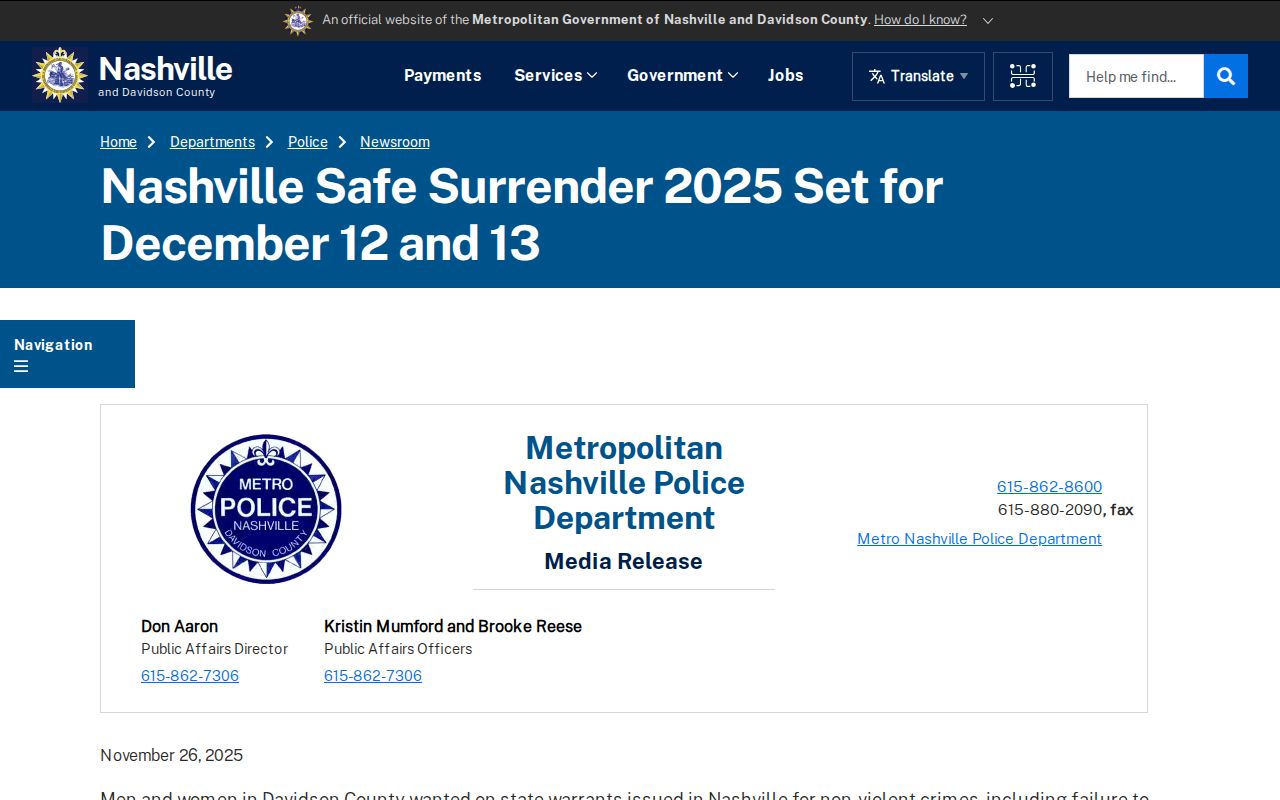
The dated notice shows one local court-access option in Tennessee, not a statewide amnesty program or a current event.
Safe Surrender Event Notice
Use the local police department's future announcements for any later dates and eligibility rules.
If You Believe You Are on a List
Think a TBI program profile carries your name or a family member's? Verify it through the agency's official site first. Never share personal information with anyone claiming they can get you removed. A public profile does not explain every court order, and it gives a private reader no access to restricted files. For an individual status question in Tennessee, talk to a defense attorney and the issuing court before assuming anything about bond, surrender, or a possible hold. The attorney can identify the right court and ask whether the warrant is still active, whether a hearing or motion is available, and which local agency to contact. Use the county directory to find that court, sheriff, or city department. An online list can lag or omit a case entirely. Only the issuing court and its records can confirm the order. And if the warrant is active, showing up can still mean custody, so ask about the local process before you go.
Important: If you may have an active warrant, speak with a Tennessee defense attorney and the issuing court about status, appearance, surrender, and bond before traveling to an office.
Tennessee's Most Wanted Coverage Is Selective
The TBI program aims to feature at least two selected fugitives from each of Tennessee's three grand divisions. That goal guarantees nothing. It is not a promise of county coverage, of representation for every region, or of a listing for every case that fits a broad description. Selection takes agency review, and the public page offers no county or agency completeness map. An unlisted area or an empty page is not evidence that no warrant exists. County sheriffs and municipal agencies across Tennessee may keep their own pages or require direct contact, and their policies differ even for similar case types. Keep the records straight. A statewide TBI listing, a local sheriff's page, a court docket, and an officer-only wanted-person entry are separate things. For a Tennessee case, the most reliable route remains the clerk and the local agency tied to the court file. Use the official TBI page to review the program's current criteria and send tips, and the county directory to reach local case records.