
Traffic Warrants in Tennessee
A Tennessee traffic warrant is court process tied to a citation nobody resolved or a hearing somebody missed. The ticket names the court that owns the case. Where it lands depends on the charge and the place. A traffic or city-ordinance matter may open in a city's own City Court, while another belongs in county General Sessions. A missed date alone does not prove a judge issued a warrant. Under local rules, the court might enter a default, reset an appearance, issue process, or take some other step. In Tennessee, FTA is short for failure to appear at a scheduled hearing. A bench warrant orders a person to appear or be brought before the judge, and a capias is the command to bring someone in. Judges use these tools in fitting cases, but an unpaid ticket does not automatically mean arrest. A Tennessee municipal citation can stay with the city court while a different traffic case sits in General Sessions. So begin at the issuing court, and treat any licensing notice as its own question.
Tennessee Traffic FTA Notices and Warrants
After certain court reports, license compliance falls to the Tennessee Department of Safety and Homeland Security. The agency runs no public OmniBase-style statewide lookup. Name and driver-license number searches for traffic FTAs or warrants are not part of its offerings. Its FTA notice instructions set a defined window for a qualifying moving-violation FTA: 30 days from notice or posting to satisfy the court matter or submit a correction, reset date, dismissal, or proof of satisfaction. That clock governs licensing only. It does not confirm an active warrant. For warrant status, ask the court in Tennessee.
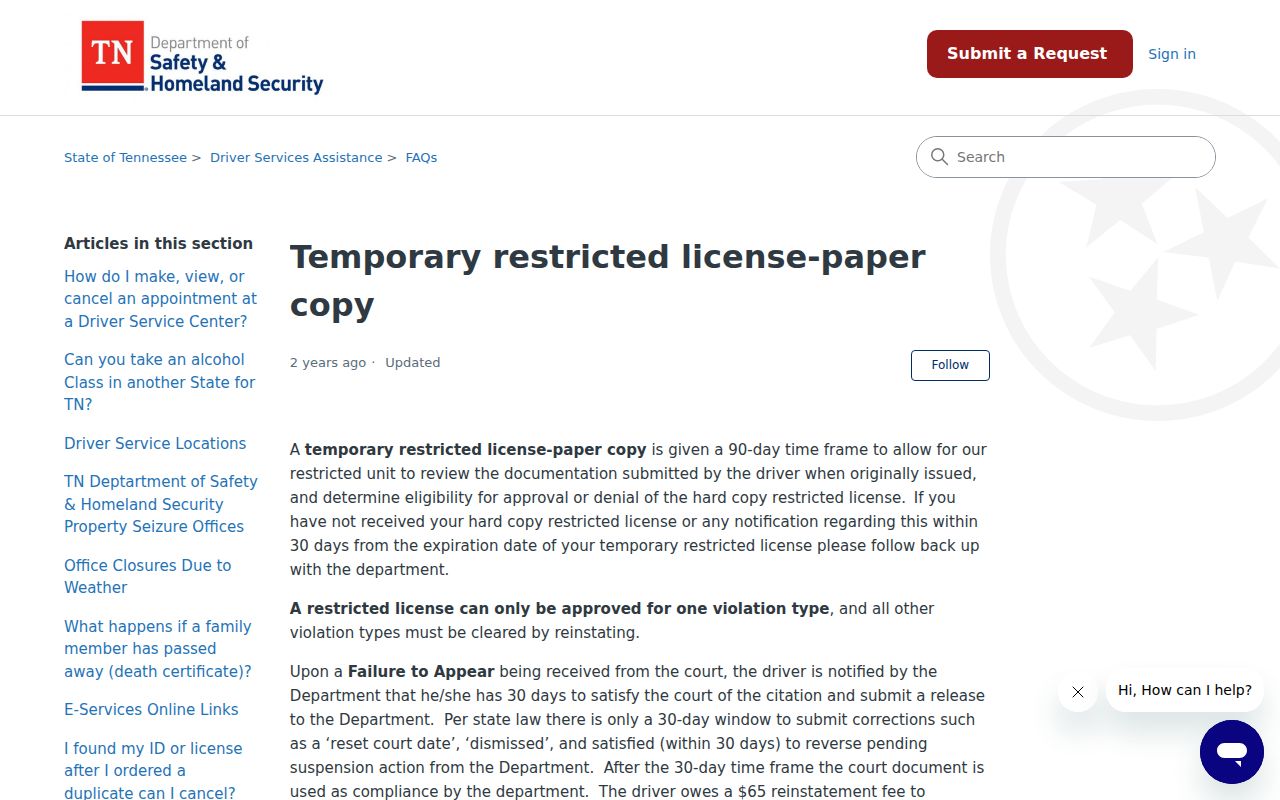
The notice shown covers a licensing response window, not warrant status and not an extension of the Tennessee court's deadline. Read the notice and its directions closely. Follow its submission steps exactly. If the response period passes, the reported court document can still support a later license action, and a separate failure-to-pay notice carries its own compliance window. Neither paper is a warrant record. A clean Tennessee licensing file still leaves the court's process question open.
Tennessee Statewide FTA and License-Hold Systems
Tennessee has no public statewide warrant or FTA lookup, nothing like a consolidated name-search database. TDOSHS e-Services handles customer compliance tasks, including document submissions and reinstatement steps. It is not a warrant query. Court case records and license records sit with different offices for different purposes. Each route answers a different question, so the case and the license need separate checks in Tennessee.
| System or Record | What It Holds | Run By |
|---|---|---|
| Public statewide warrant search | No public all-county or all-city name search was identified. | None located |
| TDOSHS notice and e-Services | License compliance, reinstatement documents, and related customer tasks. | Tennessee Department of Safety and Homeland Security |
| Citation and court docket | Local case, hearing, payment, and court-order information; a docket may not state warrant status. | Issuing City or General Sessions Court |
| Warrant process record | Whether local process is active, served, or recalled, as confirmed by the court or agency. | Issuing court and local sheriff or police |
Start with the court, and use TDOSHS only for the separate licensing item. No single Tennessee portal verifies both records at once.
Tennessee Traffic Warrant and License Holds Differ
A license hold in Tennessee is a licensing restriction that blocks renewal until required conditions are met. A warrant is court process. You can have one without the other. Tennessee updates each record on its own clock. The state's reinstatement service explains how to meet TDOSHS requirements, but it cannot recall court process or replace a call to the clerk. And paying a ticket at court does not guarantee the Department received the release paperwork. For a qualifying Tennessee FTA notice, the fix may be a court reset date, a dismissal, or a satisfaction document. Ask the issuing court what it sent. Get a copy of any proof TDOSHS wants. If the window has passed, contact both offices about the licensing step left and the case disposition. Keep each receipt or order with the notice. That way a later status question ties back to the same citation. TDOSHS reinstatement information describes license procedures, not a warrant lookup.
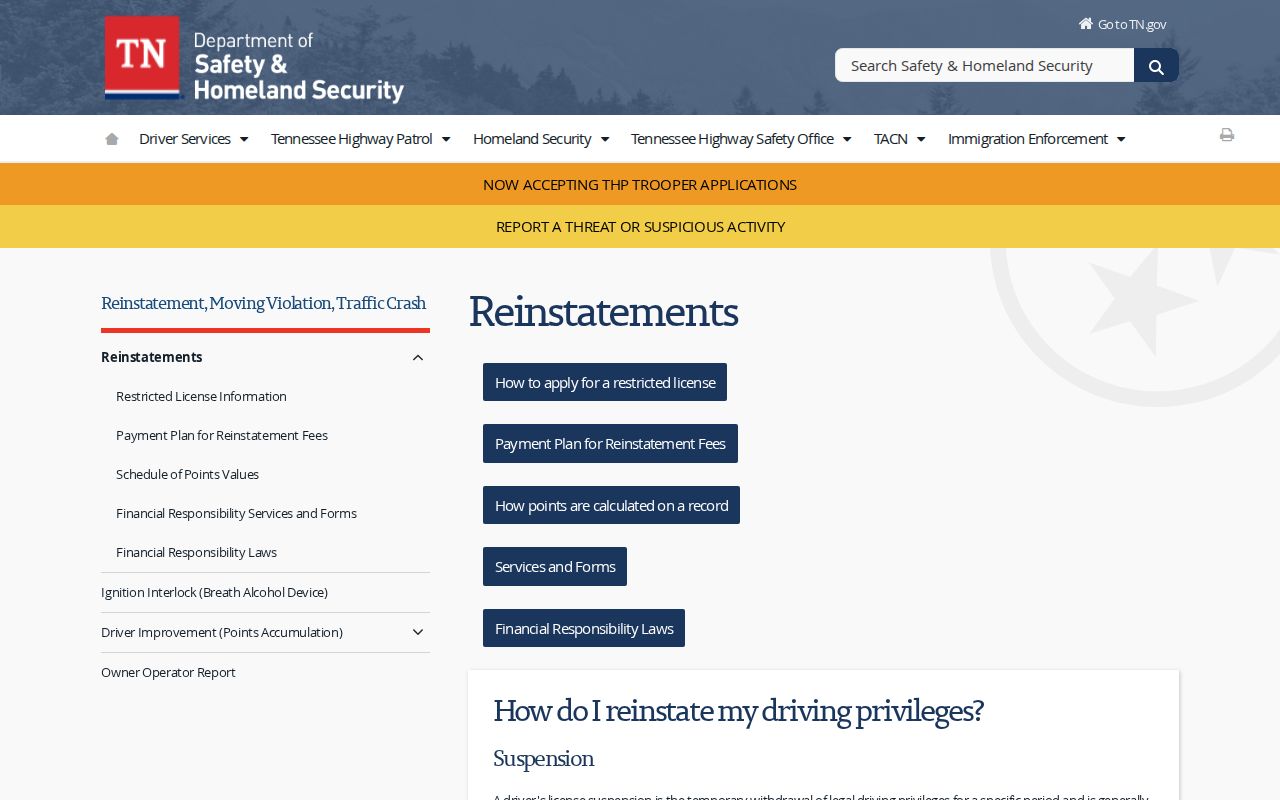
The reinstatement page helps with one license-compliance step; the issuing Tennessee court must confirm traffic-warrant status separately.
How to Check for a Tennessee Traffic Warrant
Use the record that started the case. The Tennessee Administrative Office of the Courts sends warrant questions to the clerk where the case began. Find the court printed on the ticket, notice, bond paperwork, or prior order. Papers missing? Identify the city and county first. A public case-search result can locate the citation, but ask directly whether current process is active.
- Gather the citation or case number, the name used on the filing, and the approximate court date.
- Contact the City Court or General Sessions clerk named on the document and ask about the case disposition and any active warrant or capias.
- Open the relevant location in the Tennessee county directory to reach local court and sheriff information.
- If directed, confirm operational warrant status with the county sheriff or city police warrant unit; ask how to proceed before appearing in person.
- Check TDOSHS separately if the court reported an FTA or failure to satisfy the citation.
For a paper record, ask the office for the specific citation disposition, order, or compliance record rather than a statewide list. Tennessee has no such list to request.
Tennessee Traffic Warrant Status May Be Missing
Chattanooga shows why a case lookup is not the same as a warrant search in Tennessee. The City's court-record portal finds cases by name, citation number, or docket number. Last name is required. First name, birth date, and driver-license number stay optional. A similar-sounding-names box widens name matching. Those fields locate a case record. They do not show active warrant status. A result can display the citation or docket yet skip later process, recall, or service details. When a case appears, call the clerk. Ask the Tennessee clerk whether a warrant was issued, whether it stays active, and which court controls the next step. In Tennessee, a sheriff or police record may still need separate confirmation. That Chattanooga portal is one local example, not a statewide Tennessee traffic-warrant index. See the City's court-record search instructions page for its current fields.
Paying or Lifting a Traffic Warrant
In Tennessee, the court controls both the citation and any warrant. Ask before you pay online. A hearing, reset, or motion may be required. Payment may clear the citation. Yet a warrant entry or license notice can wait for a separate update. A Tennessee recall is the court action that withdraws a warrant. Ask the clerk for proof. Get the receipt or order showing that action occurred. Chattanooga's court information page covers a missed City Court setting. A reset date requires judge approval, and the judge may enter a default judgment. That local rule does not make every missed Tennessee traffic date a warrant. The issuing court must confirm what process, if any, followed.
- Confirm the issuing court, citation number, and current case disposition.
- Ask whether the court accepts payment, requires an appearance, will consider a reset, or needs a motion to recall the warrant.
- Complete the court's approved step, then request written proof of satisfaction, reset, dismissal, or recall.
- If TDOSHS sent a notice, submit the court document through the Department's stated process and confirm the license-compliance item separately.
- Ask the clerk whether local law enforcement received the update and how to verify the warrant record is current.
Caution: A license payment or cleared hold does not recall a court warrant. Get the issuing court's disposition and confirm any law-enforcement update separately.
Tennessee Traffic Warrant Fees Stay Separate
Tennessee's TDOSHS lists a $65 fee for failing to satisfy a moving-violation citation. Its reinstatement schedule also shows $35 for a non-moving citation. Those are licensing-compliance fees. They are not the ticket fine. They are not local court cost, bond, or warrant-recall charge either. Confirm the category and amount against the live state schedule before paying. Tennessee sets no uniform statewide amount for traffic-court costs or warrant fees. The city or county court sets its own. It can explain payment online, by mail, or in person. A bond is not a TDOSHS reinstatement fee. Bond is the court-set amount or condition tied to release or appearance. Ask for a case-specific total. Then keep receipts from each Tennessee agency. The Department's published reinstatement fee schedule lists the state compliance amounts.
Traffic Warrant vs Driver Record
Court records and driver's license records answer different questions in Tennessee. A traffic warrant is court process tied to a case. A license hold is a separate compliance status. TDOSHS manages it after a qualifying report. A notice from one office does not prove the other record's status.
| Question | Traffic Warrant Record | License-Compliance Record |
|---|---|---|
| Who controls it? | The issuing court; local law enforcement can confirm operational process. | TDOSHS, based on qualifying reports and compliance documents. |
| What does it answer? | Whether a court has issued process and what action is required. | Whether a licensing requirement or reinstatement step remains. |
| How is it checked? | Ask the issuing clerk, then the local sheriff or police if needed. | Follow the notice and TDOSHS reinstatement process. |
| How is it cleared? | Follow the court's payment, appearance, bond, or recall order. | Submit the required court proof and complete applicable state steps. |
A resolved license hold can coexist with a court case that still needs attention. The reverse also happens. Neither status changes the other record by itself.
Tennessee Traffic Warrant Recall Needs Proof
Get proof after payment, a reset, or a court appearance. Ask for a receipt, docket entry, or signed order. Confirm the sheriff or police unit got notice. It may keep a separate process record. Then check the license side. TDOSHS may have sent an FTA notice. A planned payment is not a Tennessee recall order. A future appearance is not one either. The online docket may lag behind an agency's Tennessee record. If routine contact turns up nothing, a Tennessee citizen can file a Tennessee Public Records Act request. Direct it to the clerk or agency holding the record. Describe the city or county, citation or case number, date range, and record sought, such as a disposition or notice. TPRA does not create a statewide warrant index. Nor does it require a custodian to write a new legal-status report. Ask the local custodian about its request form and any access limits. The Comptroller's TPRA guidance explains custodian-specific requests and public-record access.